Happy Hour & Reception Photography
How We Photograph a Happy Hour
The photos of your reception have one job: put the viewer in the room. Whoever opens the gallery later, a guest reliving it, an exec who skipped it, a prospect deciding about next year, should wish they'd been there. That's a harder assignment than covering a keynote: no stage light to expose for, no run of show, and light that changes by the half hour. Here's how we photograph that night, in the order it happens.
How does Vetter Event Group photograph a happy hour or cocktail reception?
We photograph receptions through the eyes of a guest, working to a written standard rather than improvising, so the viewer of the photos experiences the night rather than observing it. Exposure is set for faces, white balance is set by hand for mixed bar light, and flash is never pointed at anyone. The room gets framed tight early and wide only once it has filled, so the gallery carries the energy of the night you actually hosted.
Your Delivered Gallery
Conversations, connections, and the room around them
A representative slice of a reception delivery, in the order it lands in your gallery. Not a highlight reel: the room before doors, the details, the conversations, the food, and the frames at full tilt, because that whole range is what you actually receive. Click any frame to see it full size.
In the final edit
A gallery that feels like being in the room
We look for the exchanges that made people stay: introductions, laughter, and conversations with the room around them. Details and wider views give those photographs a setting.
- Eye contact and animated conversation between guests
- The bar, lounge, and crowd visible around the people
- Fresh drinks and food details with clean backgrounds
- Full-room photographs taken when the reception is in swing
Let the reception find its rhythm
- Arrivals and small conversations first, wider crowd photographs as the room fills
- Informal group photos once guests have settled in and welcome the camera
- Both faces sharp in a conversation, with enough of the room to place them
- Cocktails and food stations photographed fresh, before service changes them
- Sponsor details paired with photographs of guests engaging around the brand
- Light balanced for recognizable faces and the atmosphere of the venue
Before doors: the event you designed
The story starts the way a first guest experiences it: walking into a finished room. Clean wide shots of the space, the signage, the custom decor, the bar with the glassware still in the order somebody placed it. These frames have a fifteen-minute life and then they're gone for the evening, and they're what lets a viewer step through the door of your event instead of arriving at a party already in progress. Details get shot wide, medium, and macro, with distracting elements moved out of frame and any text sharp and readable. This is also when white balance gets set, manually, for each space we'll shoot in: the bar, the patio, and the room off the lobby are three separate lighting situations, not one venue.
The first thirty minutes: a thin room, framed honestly
Every reception has the same arc, and the first thirty minutes are the trap. Photograph wide then and a well-attended event looks abandoned in the recap, and no one wants to be at an empty party, in person or in a photo. Our standard is blunt about it: don't shoot empty chairs, frame tight while the room is thin, and hold the wide shots until the room has earned them. Early coverage goes to arrivals, check-in, and the first conversations, and the establishing frames arrive later in the shoot than instinct suggests. The gallery ends up carrying the night you remember, not the first twenty minutes of it.
Food and bar, while you can still taste them
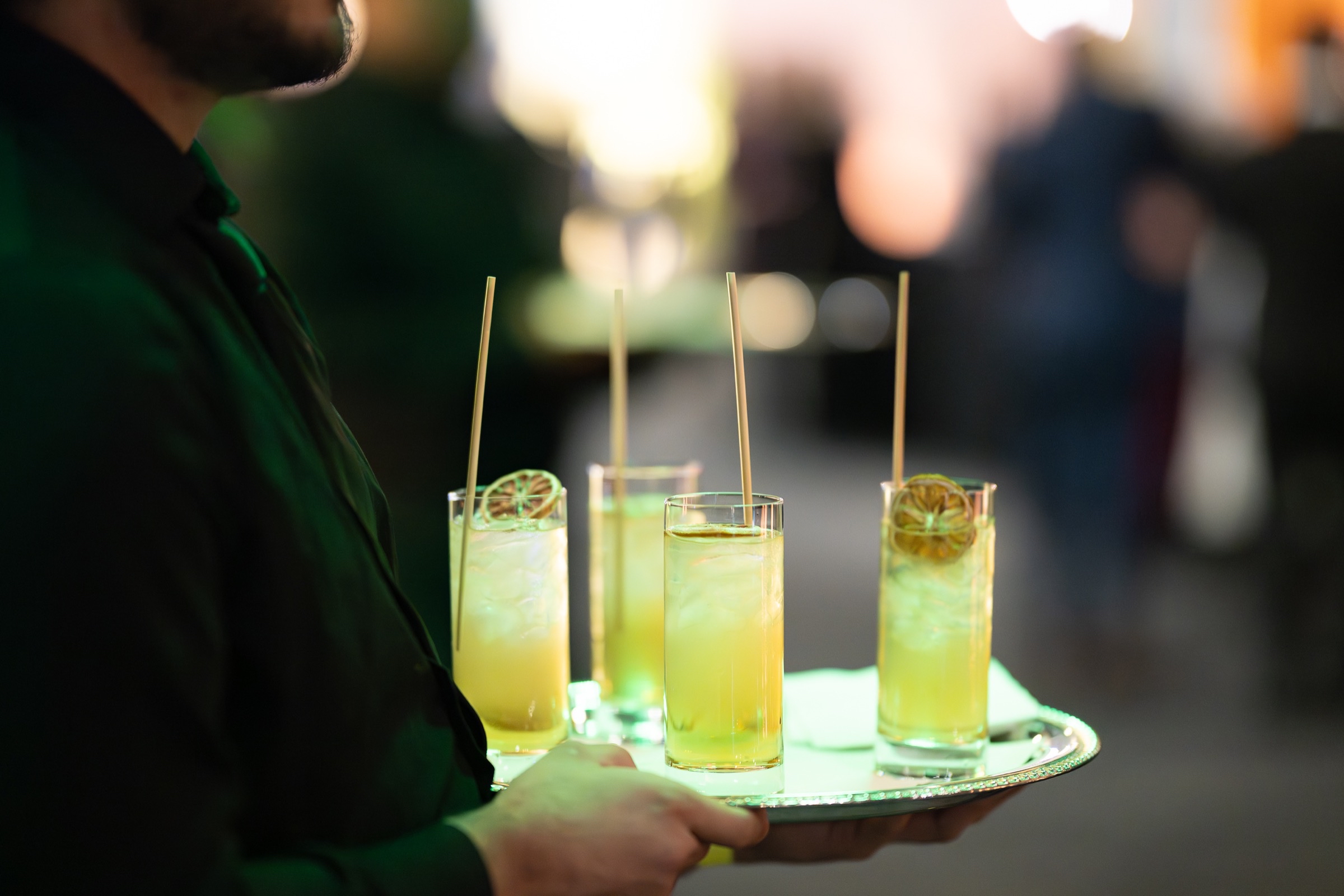
A viewer should look at the food and want it, which is why it gets shot early, while it looks the way the caterer intended. Full trays and full displays only, never a station that's been picked over, never the prep side of the operation. And because appetite in a photo dies the moment you watch someone else chewing, nobody is photographed actively eating, at any point in the night. Holding a plate is fine, and we keep the food out of frame where we can. When servers appear in a shot they're engaged in the work rather than looking at the lens, which keeps the viewer inside the evening instead of reminded of the machinery behind it.
The working room: candid, and out of the way
Once the room is going, the rule is stealth. Nobody gets asked to look at the camera yet. The team wears all black and quiet shoes, stays out of sightlines, and works the conversations as they happen: laughter, animation, the moments that are the actual reason the event exists. Those moments only survive in a photo if they were never performed for one. This is the stretch of the night where a photographer who needs to be noticed does the most damage, and where ours is doing the best work.
Faces first, in a room lit three colors at once
The light in a reception room is usually neon or LED signage, tungsten uplights, candles, and whatever daylight is left through the windows. Auto white balance averages that into a color cast nobody's skin actually has, which is why ours was set by hand at walk-in: the room should look the way it felt to stand in. Exposure works the same way. We meter for the face and let windows and fixtures blow out, because a bright background is a fair trade and a dark face never recovers into someone you recognize. Where the room is too dark or too saturated to hold clean color, flash goes on, always bounced or modified, never pointed at anyone, for accurate skin and catchlights. Catchlights are the small point of light in a person's eyes, and they're the difference between a face that looks alive and one that looks printed.
The conversation you can step into
The most valuable frame at a reception is two people genuinely talking, and it's where the pretty instinct is wrong. Shallow depth of field makes a single portrait sing, so the reflex is to shoot the whole night wide open. But a conversation only pulls the viewer in if both faces are sharp; blur one and the viewer is watching from outside instead of standing in it. So our standard discourages shallow focus the moment a second face enters the frame, no exceptions, and the closest person to the camera is always sharp. The same thinking governs context: a tight shot with no surroundings is half a photograph, so people get placed in the scene, with the bar and the room and the crowd behind them, because that's what lets a viewer feel where they're standing.
Branding, worked into the night four ways
Sponsor and brand coverage runs through the whole evening as a defined deliverable, not something that happens by accident inside wide shots. Four distinct framings, because each gets used differently downstream: clean closeups of branded items in good light, wide frames placing the branding in the context of the room, branded items with engaged guests behind them, and engaged guests with the branding behind them. The first two get shot early, while things are clean. The last two can only be shot once the room is full, and they're the two a sponsorship team actually needs and the two most often missing when someone else shot the event.
Cocktail time: when posed shots become welcome
Somewhere past the first drink, the room changes, and this is the rule that most changes how a reception feels: nobody gets asked to look at the camera until that moment. Once people have settled in, the switch flips. Informal group shots stop being an interruption and start being something guests ask for, and camera-aware frames come back warm instead of stiff, groups of people who look like they belong together and are glad to be there. That's the frame that makes someone scrolling later want in. Ask too early and you get a forced set and a room that's aware of you for the rest of the night.
Entertainment, shot from where the guests stand
If there's a band, a DJ, or a performer, they get covered two ways: wide with guests visibly enjoying it, because the story is the room's excitement and not the act itself, and tight on the action for the energy. Then we move on. A gallery where forty percent of the frames are the same guitarist is a gallery your marketing team has to dig through, and it tells the story of the band's night instead of your guests' night.
The people who built the night
If a production agency built the room, or a partner agency brought us in, their people working is on the shot list rather than treated as a courtesy. Agencies almost never have photographs of their own team doing the job, and those frames are how a good partner gets to show what they delivered. Client-side staff running the night get the same treatment.
After the last frame: how the story gets assembled
We don't overshoot, because every frame captured is a frame that has to be culled and processed, and volume is not the same as coverage. In post we cull hard: no more than two versions of any near-identical image, and no more than three or four frames following a single moment, so the gallery reads like the night and not like surveillance of it. On site, cards are never wiped, each camera runs two of them, and the backup copy stays intact until the work is delivered. If more than one photographer is on the night, every camera shoots TIME.GOV at call time so the bodies are time-synced and the delivered set assembles in true chronological order. Someone opening the gallery walks through your evening the way a guest did: the finished room, the first arrivals, the food, the conversations, the toasts, the crowd at full tilt. That's the experience that makes the person who missed it decide not to miss the next one.
The Practical Details
Rates, paperwork, and the rest of the program
This page covers how the room gets shot. The commercial and logistical details live where they belong.
Related Services
Explore connected event coverage
Common Questions
Frequently Asked
Our reception is in a dark bar. Is that a problem?
It's the normal case, not the hard case. White balance gets set manually for that room rather than left on auto, since bar lighting mixes neon, tungsten, and whatever daylight is left. Exposure is set for faces and backgrounds are allowed to go bright. Where the room is too dark to hold a clean frame, flash goes on bounced or modified, for accurate color and for catchlights, never pointed at anyone.
Can you get both people sharp when two guests are talking?
Yes, and it's a written rule rather than a preference. Shallow depth of field is encouraged for a single subject and discouraged the moment a second face is in frame: two people talking means both faces sharp. If the closest person is looking at the camera, they have to be sharp. Groups get shot at a smaller aperture again so nobody in the back row goes soft.
The room will be half empty for the first half hour. What do you do?
Frame tight and wait. Wide room shots get held until the room has filled enough to earn them, and empty chairs don't get photographed at all. It means the establishing frames come later in the evening than you might expect, and it means your recap doesn't open with a picture that makes the turnout look like a disappointment.
Will your photographer interrupt conversations?
No, and the timing is deliberate rather than a matter of personality. Nobody is asked to look at the camera until cocktail time, so through the early part of the evening we work candid and stay out of the way. The team wears all black with quiet shoes and a visible name badge, and stays out of sightlines. Once people have settled in, camera-aware shots become welcome, and that's when we take them.
There are screens or an LED wall behind the bar. Will they band in photos?
Not if the shutter speed is set for them. LED screens and displays flicker at rates that produce banding at common shutter speeds, so shutter speed gets adjusted for those frames specifically. It's a known condition we plan for rather than something discovered in the edit.
How do you photograph our sponsor branding?
Four distinct framings, because each one gets used differently: a clean closeup of the branded item in good light, a wide frame that places it in the room, the branded item with engaged guests behind it, and engaged guests with the branding behind them. Any text in the frame is shot sharp and readable. The last two framings are what a sponsorship recap actually needs.
Do you photograph the food and bar?
Yes, and early. Fresh, full displays only, never a picked-over station and never the prep area. Nobody gets photographed actively eating, holding a plate is fine, and where servers appear they're shown engaged in the work rather than looking at the camera. Food matters more at an evening event than anywhere else on an agenda, which is why it gets shot while it still looks the way the caterer intended.
If you send two photographers, do the photos come back in order?
Yes. Every camera photographs TIME.GOV at call time, which time-syncs the bodies against an authoritative clock rather than whatever each one happened to be set to. The delivered set then assembles in true chronological order, which matters when you're pulling a sequence out of it later. Cards are never wiped on site, and each camera carries a backup copy.
Let's Scope Your Event
Tell us what you're planning and we'll respond within 24 hours with the next best step.
Get a Quote